Appendix C: Complex Numbers
The "imaginary" (and here I could insert at least three pages lamenting the terrible crime of using such an anti-descriptive slur to refer to this fierce, fierce number) unit is defined by its behavior when multiplied by itself, namely
.
Any number which is a real-multiple of the imaginary unit is called an "imaginary number". For example, is an "imaginary number". By contrast, is a "real number."1 Real and imaginary numbers can be multiplied together (which is what we did in the construction of just a moment ago) and they can also be added together. Adding a real number to an imaginary number creates a new two-component number of a more general category: the complex number.
To construct a complex number by addition, you simply write it out and then leave it as is; no further simplification is needed (or persay possible). For example we could add to and get the complex number . We could even write it since addition is commutative, though this is less stylistically conventional. In general, any complex number can be written as a combination of its "real part" and its "imaginary part" in the form
.
This specification of a complex number is rectilinear. You can think of its real and imagnary parts as being a bit like "x" and "y" coordinates (in fact it isn't uncommon to use those variable names in place of "a" and "b" when specifying the number in the first place) of an ordered pair. Once concieved of in this manner, all of the complex numbers can be assembled into their natural, two-dimensional home: the complex plane.
Singularities
Functions occascionally have certain areas of their domain where their value is undefined. This is sometimes a matter of construction: for example you could define your function to be defined only on integers, in which case it is undefined for any non-integer input. Sometimes, though, it is a result of a deeper principle. See in Figure 1.1, for instance, the function , which is undefined at . This is because division by zero is illegal, and anyway if we were to assign it some abstract value of "infinity," we'd still have ambiguity between the Red Infinity (limit as from the right) and the Cyan Infinity (limit as from the left) which lie at opposite ends of the real line. We could take the Riemannian approach and glue these two infinities together as a single defined entity; but this is getting ahead of ourselves by just a bit.
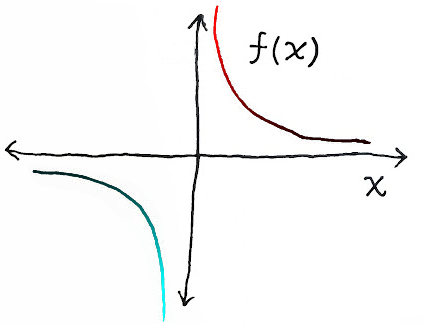
The point is that the above function has exactly one single point at which it becomes undefined; hence "singularity." In the olden days, singularities were generally regarded as a nuisance; if a function is meant to represent some kind of physical quantity, and all observable physical quantities are to be regarded as finite, then an explosion to infinity is an increidbly annoying thing. The early days of quantum field theory, for example, were considered 'plagued by infinities' before it was discovered that this was a feature rather than a bug of the theory [1]. If we stick to just the real numbers, this perspective is understandable.
Let us therefore be modern people and plot this function in the complex plane instead.
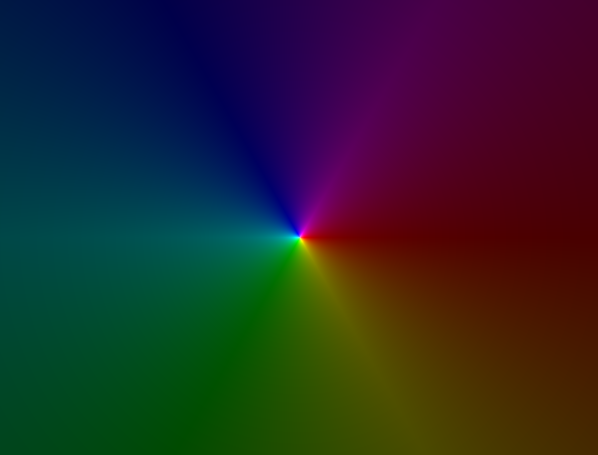
Henceforth when we discuss "singularities," we will be talking about something that looks like this.
1 And here I must somehow keep my anger under wraps. How dare we call this number 'real' and that number 'imaginary'. We may just as well call the negative numbers 'fake' and the positive ones 'true' for all the sense it makes. Next shall we call the integers 'natural' and the non-integers 'unnatural'? Shall we call the ratios-of-integers 'rational' and the rest 'irrational'? Oh wait that's exactly what we call them. Hm. [strike please this entire footnote]