Chapter 1: Early Equivalencies
The dynamical-systems approach to studying the natural world was by far the favorite of our preterluminary forebears. This is because early physystry (that ancient science from which analytical ontology descends) was built on the concept of mechanics, which concerns the study of motion. When considering problems like the operation of a sprocket-powered timekeeping device, or the orbital path of a nearby astral body, or the probability for two atoms to combine into a compound molecule, this preference is understandable—very useful, even. That is because in these situations, the relativistic structure of spacetime and the status of "matter" as an emergent phenomenon can be safely ignored.
Numinology, by definition, cannot ignore these things. We are here to study the nature of reality itself on the most fundamental level, and must place everything in its most natural setting. We do not have the luxury of ignoring the universe's most exotic properties, and we do not want that luxury—indeed for our purposes any such simplifications would only serve to muddy the waters through which we wish to peer. As such we will of course be sticking to a manifestly frame-covariant approach at all times1.
Dynamical Notions
If something is changing, it is traditional to regard it as a function of time.
If you want to know its state at a specific time, plug in that value for .
The universe, which does indeed change in time, is also different at different points in space. So when we describe its local qualities, we had better specify a set of spatial coordinates too:
.
Now we're being specific about where and when in the history of the universe we are talking about. is therefore no longer a dynamical system, but a field. Its governing laws relate the qualities of to its surroundings at nearby points in all four dimensions, rather than simply its state "before" and "after."
Of course, it is up to you how you choose your coordinate system. Due to the tenfold isometry of spacetime, you can choose any event in spacetime as your reference point, and can apply any type- rotation to your coordinates and obtain another perfectly valid set. This puts all four spacetime coordinates on the same footing: they mix together as we change our frame of reference.
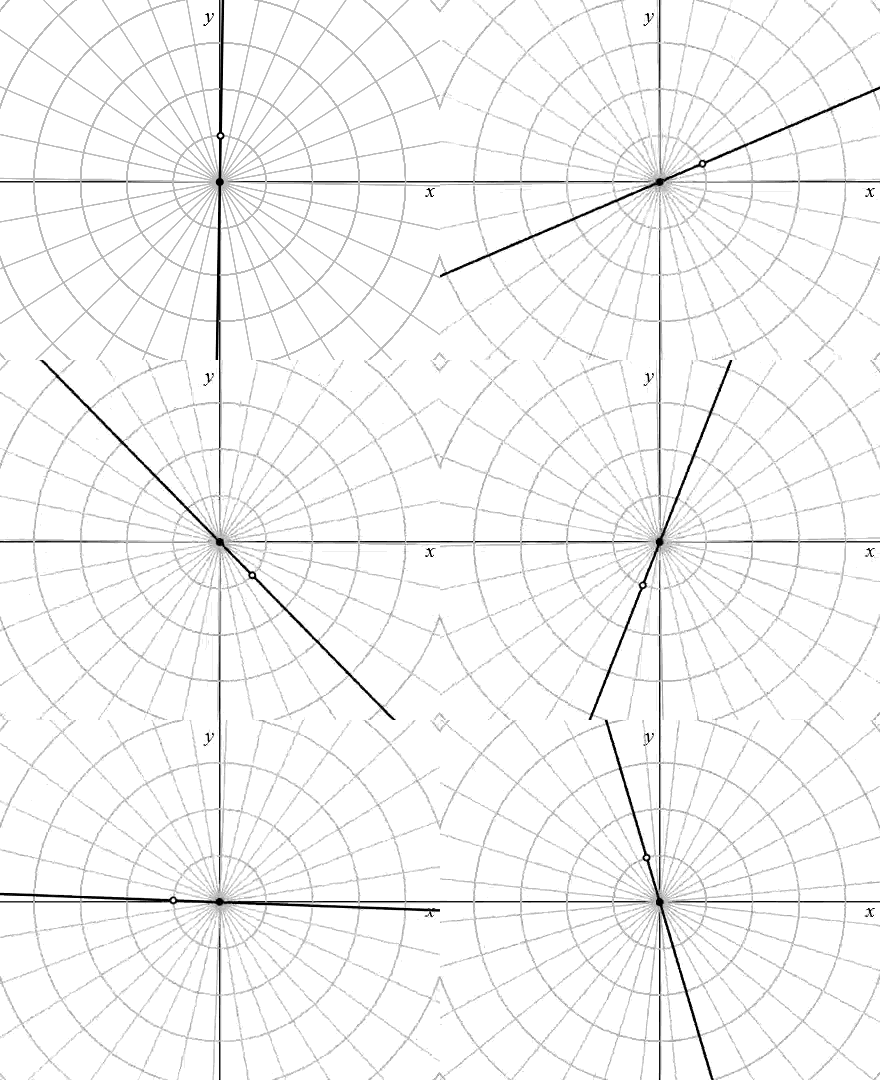

Choosing a coordinate system means choosing a temporal axis and singling out an arbitrary notion of present, thusly inducing an unnatural foliation on spacetime. In the preterluminary period, it was thought that you had to construct a "system" in order to analyze anything; the "time-evolution" of this system was then the object of analytical pursuit. Therefore the foliation of spacetime was considered desirable; each 3D slice of the 4D whole was taken as the "system state" at a different time.
This is an example of a dynamical notion. The history of the universe stands as one unmoving whole across all spacetime, and yet in order to to study it in a way which matches our biological perceptions we have to foliate it into spacelike slices and attempt to solve for its evolution dynamically. It would be more natural to solve for its whole structure at once, but we may not always need to study the entire universe. Most of the time, we are only analyzing a very small part of it. In the numinous sciences, however, one concerns themselves with
1 There are those who seek to revive the dynamical systems approach, citing its historical significance and myriad successes in solving the practical problems of prior centuries. The author thinks this is an inspired idea. Truly visionary. What better way to appreciate the obsolete theories of the past than to use them in our daily lives? Why not also rehabilitate the preterluminary economic theory while we're at it. Clearly antiregulated producer-consumerism was unfairly put to rest after a paltry millenium of dominance. Perhaps it just needs another century or so to trickle fairness into our society and really show its worth. And let's not stop there: the biomedicincal sciences of the Century of Loathing want their day in the sun, too! Let us revisit the theory of humours and miasmas; they were never really given their fair shake, what with the theory of germs coming along to spoil the fun.