Chapter 1: Theoretical Background
Augustin-Louis Cauchy could not have known at the time that his simple (though exemplary in its elegance) formula for evaluating certain complex integrals held the key to unlocking the space between realities, but we of course have the benefit of hindsight. To make use of this advantage, the text will in general strive to explain the numinous significance of each step as we take it, rather than speaking in terms of the purely abstract. Still, there will be times where we must first explore a mathematical concept in bare generality so that its physical significance can properly be appreciated later down the line. During these times the reader may find it useful to put some faith in the cornerstone precept of all theoretical physics: that mathematics of even the most obtuse variety are, when taken in the right setting, eminently useful. The universe, after all, frequently chooses to be obtuse.
If this proverb requires a bit too much filial piety on the reader's part, they might consider trusting instead in the operative principle of this book: namely, that I know what I am doing.
A basic familiarity with complex numbers is assumed. For a non-exhaustive introduction to this subject, see Appendix C.
Early Meromorphisms
We begin with the concept of the singularity.
Functions occascionally have certain areas of their domain where their value is undefined. This is sometimes a matter of construction: for example you could define your function to be defined only on integers, in which case it is undefined for any non-integer input. Sometimes, though, it is a result of a deeper principle. See in Figure 1.1, for instance, the function , which is undefined at . This is because division by zero is illegal, and anyway if we were to assign it some abstract value of "infinity," we'd still have ambiguity between the Red Infinity (limit as from the right) and the Cyan Infinity (limit as from the left) which lie at opposite ends of the real line. We could take the Riemannian approach and glue these two infinities together as a single defined entity; but this is getting ahead of ourselves by just a bit.
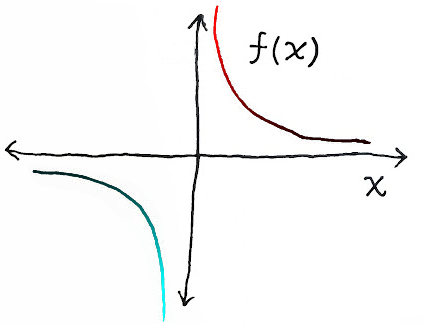
The point is that the above function has exactly one single point at which it becomes undefined; hence "singularity." In the olden days, singularities were generally regarded as a nuisance; if a function is meant to represent some kind of physical quantity, and all observable physical quantities are to be regarded as finite, then an explosion to infinity is an increidbly annoying thing. The early days of quantum field theory, for example, were considered 'plagued by infinities' before it was discovered that this was a feature rather than a bug of the theory [1]. If we stick to just the real numbers, this perspective is understandable.
Let us therefore be modern people and plot this function in the complex plane instead.
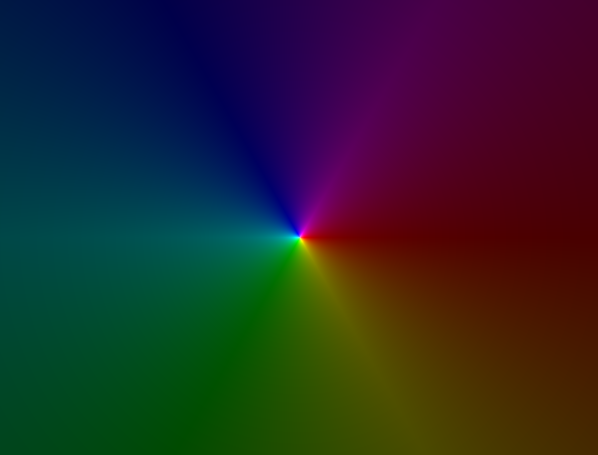
Henceforth when we discuss "singularities," we will be talking about something that looks like this.